SPEECH-LANGUAGE TREATMENT
Receptive & Expressive Language
Receptive & Expressive Language
Receptive & Expressive Language
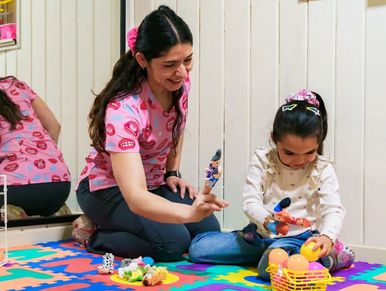
Receptive Language Delay: Difficulty understanding language, making it hard to follow directions, answer questions, learn new words, or grasp complex sentences.
Expressive Language Delay: Difficulty with vocabulary, forming sentences, and using correct grammar. Using fewer words or shorter sentences than peers.
Articulation
Receptive & Expressive Language
Receptive & Expressive Language

Speech Sound Disorder: Difficulty producing individual speech sounds, often involving errors like substitutions (e.g., "wed" for "red"), omissions (e.g., "nana" for "banana"), or distortions (like a lisp on 's'), affecting the production of sounds rather than sound patterns, and may stem from motor-speech issues or structural problems.
Fluency/Motor Speech
Receptive & Expressive Language
Fluency/Motor Speech

Stuttering: Disruption in the normal flow of speech, including repetitions (sounds, syllables, words), prolongations, and blocks - involves difficulty getting words out smoothly, often with tension, eye blinking, or lip tremors, and can lead to anxiety about speaking.
Apraxia of Speech: Difficulty planning and coordinating mouth movements (lips, tongue, jaw) for speech, leading to inconsistent errors, slow/halting speech, groping, and difficulty with longer words
Aphasia
Pragmatic Language (Social Skills)
Fluency/Motor Speech

Aphasia is a language disorder caused by brain damage (often from a stroke) that impairs the ability to speak, understand, read, or write, find words, form sentences, comprehend speech, and even math. Symptoms range from mild word-finding issues (anomia) to severe language loss (global aphasia)..
Voice/Dysarthria
Pragmatic Language (Social Skills)
Pragmatic Language (Social Skills)

Voice disorder (Dysphonia): Abnormal vocal quality, pitch, or loudness, making voice sound different, strained, or difficult to use, often due to vocal misuse, physical changes in the vocal cords (like nodules or paralysis), or neurological issues.
Dysarthria: Muscle weakness or paralysis affecting the mouth, face, and respiratory system, making speech slurred, slow, or difficult to understand.
Pragmatic Language (Social Skills)
Pragmatic Language (Social Skills)
Pragmatic Language (Social Skills)

Pragmatic Language Disorder: Condition affecting use of language in social situations. Difficulties with social communication, conversational rules, understanding nonverbal cues (e.g. gestures, eye contact), adjusting speech for different people, using language for social purposes (e.g. greeting or asking), forming friendships, participating in group settings, and understanding things like jokes or sarcasm.